
Chiron writes books and primers to order, reads the things you already wanted to read (imported EPUBs, PDFs, web pages, blogs you follow), and keeps all of it on one shelf. The point of putting them together is the highlight: a passage you mark in anything on that shelf reaches the tutor with the whole chapter behind it, so the answer is about the argument you are reading rather than a sentence torn out of it. What it writes for you is shaped by what you have read and answered, which it remembers.
A server holds the material and the learner record. Apps for iPad, iPhone, and Mac read from it and sync, so a chapter you mark up on one device is marked up on the others. Reading works with the server out of reach, and on recent Apple hardware a question asked offline is answered by the on-device model from the chapter alone rather than not at all.
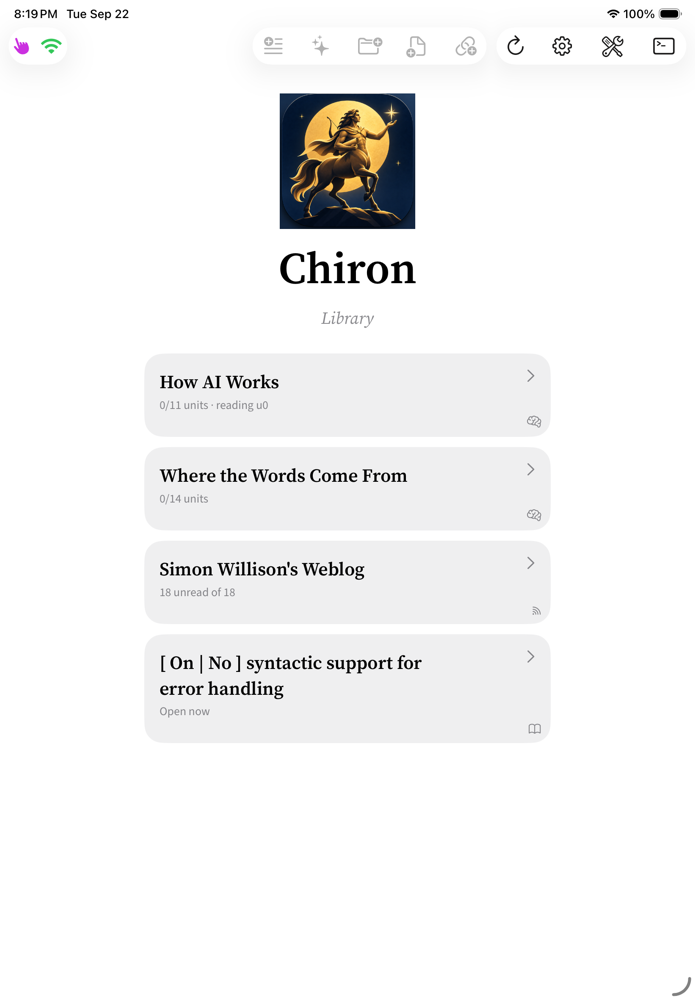
The library. Books it wrote, blogs followed by feed, pages and documents saved to read, all as cards on one shelf.
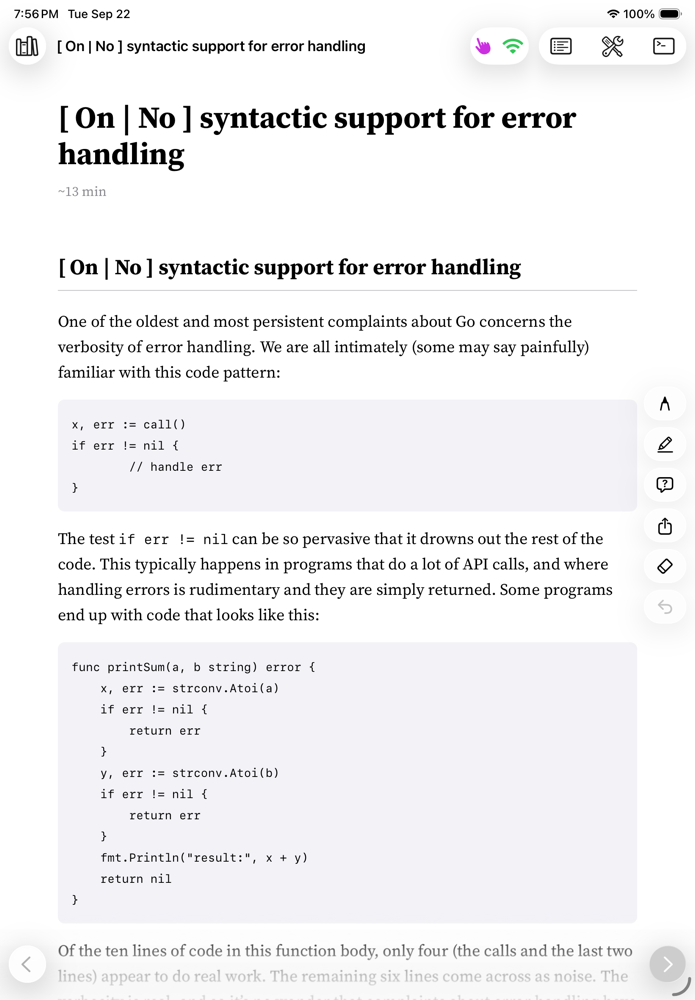
A page read in Chiron. Any URL comes in as its own article, with its code and pictures kept, ready to highlight.
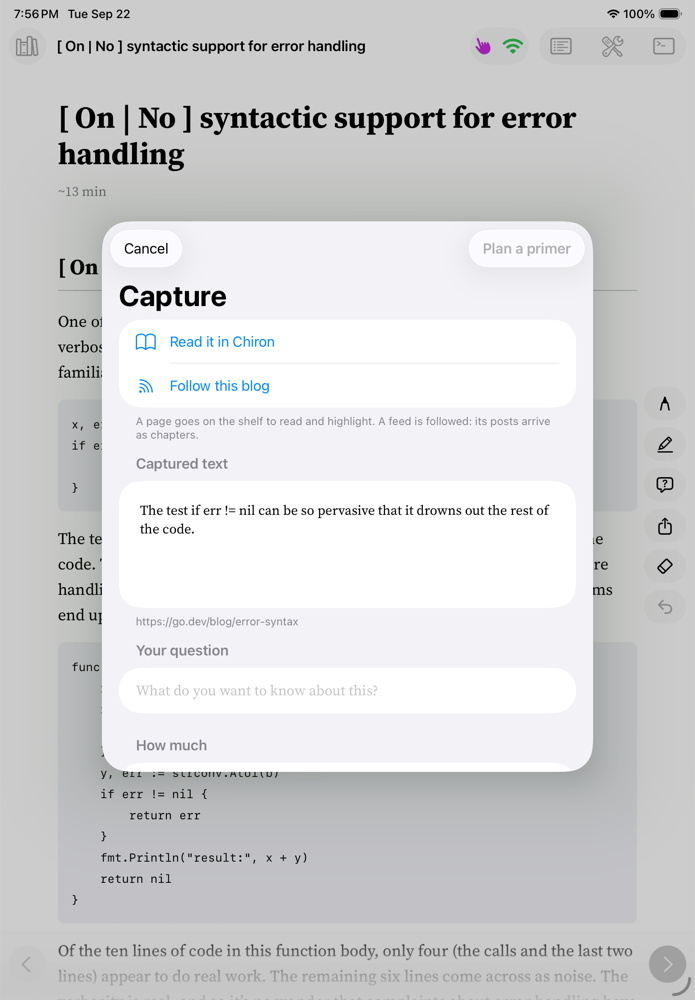
Capture. Highlight anything, ask a question, and say how much you want back: a summary, more detail, a primer, or a whole book.
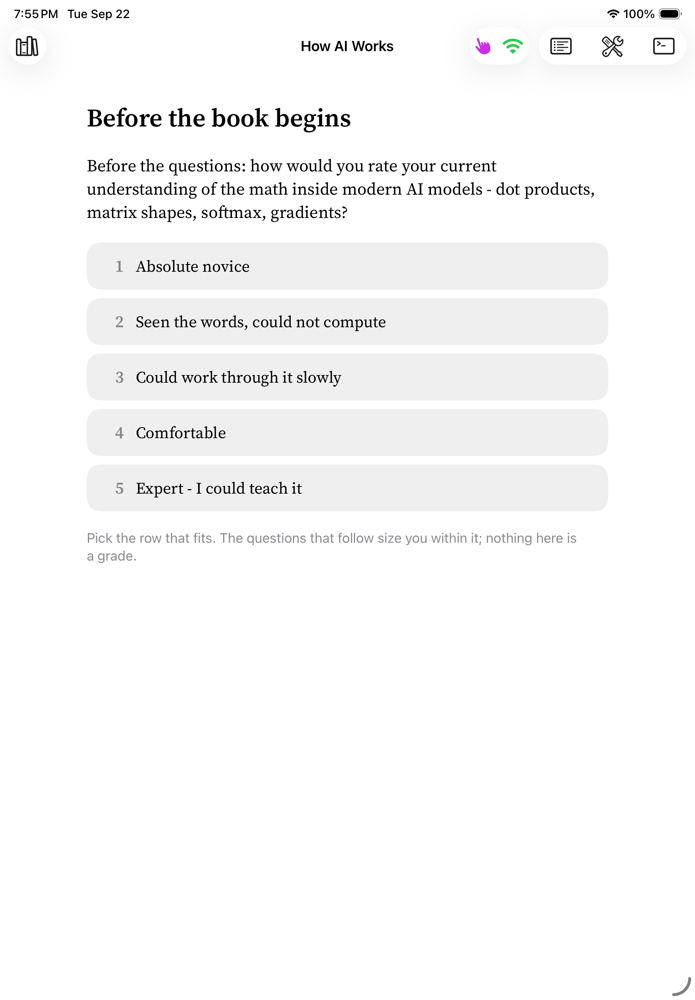
Before a book begins. A short screener places you, so the first chapter is written for the reader you actually are.
How it works
You feed it something (a passage, a file of notes, a link, a question) and say how much you want back. A summary or a bit more detail comes back in the card. A primer or a book goes through a short planning conversation first, then a brief, and then a model writes it; it lands on the shelf as real chapters with exercises and checks. Books are taught rather than just displayed: you read a chapter, work the beats inside it, take a cumulative check, and what comes next depends on how that went.
Everything else on the shelf is read as it is, with nothing invented on top. An EPUB keeps its own chapters, a PDF its pages, a web page its article, a followed blog its posts, and all of them accept highlights, questions, and Apple Pencil annotations that sync between devices.
Why it is built this way
The design follows the evidence on what actually moves learning.
- Interaction lives inside the chapter, not after it. Every chapter carries a handful of beats (predict the next step, fill in a blanked derivation, explain why a term is there) that you commit to before the reveal.
- Wrong models are the teaching material. Every unit ships a misconception bank, and every wrong answer is a diagnosis rather than a miss.
- Remediation switches representation. Failing a check does not re-present the same text more slowly. It swaps symbolic for numeric, or geometric, or code.
- The gate is a default, not a wall. You can always move on. Skipped material accrues as knowledge debt, and “catch me up” later writes one consolidated chapter covering it.
- Confidence is recorded before every reveal. High-confidence-wrong is a misconception and gets refuted; low-confidence-right is fragile and comes back later.
- The model supplies judgement, code supplies everything else. Mastery, prerequisites, gating, and check composition are deterministic, so what gets asked does not vary with a model’s mood.
Platforms and availability
| Apps | iPad, iPhone, and Mac |
| Server | A single static Go binary you run on your own machine or host |
| Models | A local model through LM Studio, or a hosted model through the Anthropic API or a Claude subscription |
| Offline | Reading, marking, and on-device answers on Apple Intelligence hardware |
| Distribution | Currently to testers through TestFlight. Not yet on the App Store. |
| Licence | MIT. Source at github.com/mjbraun/chiron |
Chiron is designed to be self-hosted. Akartis does not operate a Chiron server on your behalf, and your reading, highlights, and learner record stay on your devices and on the server you run. See the Chiron privacy policy for the details.
Support
Questions, bug reports, and feature requests go to hello@akartis.net or to the issue tracker on GitHub. The support page has answers to common questions and what to include in a report.